

What does the future look like for Nepal’s marginalized communities?
On fears that inclusion and representation could be sacrificed on the altar of progress and development


Good morning, good afternoon, and good evening from Kathmandu. This is Issue 231 of Kalam Weekly, the only newsletter you need to keep updated with everything happening in Nepal.
We have a new prime minister, a new government, and a new House of Representatives, but we also have a new guest essay. This week, Subeksha Poudel takes a closer look at how inclusive the March 5 election was and what that portends for Nepal’s marginalized groups.
Read the full story in the deep dive below.
In this newsletter:
Balen Shah elected prime minister, announces new Cabinet
Gen Z protest investigation commission report leaked
The deep dive: What does the future look like for Nepal’s marginalized communities?
Balen Shah becomes prime minister, announces new Cabinet
On March 27, Friday, Balen Shah was administered the oath of office by President Ram Chandra Poudel, formally appointing him as Nepal’s new prime minister. The oath-taking was akin to a coronation. Priests blew conch shells as if announcing the arrival of a wartime general. A hundred and eight Hindu ‘batuks’ chanted the Swasthi Shanti, alongside 16 Buddhist monks who recited the Ashtamangala. Both these hymns are considered auspicious for new beginnings in the Vedic Hindu and Buddhist traditions, respectively. Shah took the oath at exactly 12.34 pm, a supposedly auspicious time in Hindu numerology.
Many were uncomfortable at this decidedly religious pomp and ceremony. Shah made a point to include both Hindu and Buddhist traditions, but Nepal is a secular country, and a head of government using his personal faith to enter office rubs the wrong way. Shah is free to practice his religion, but secularism demands that religion be kept separate from matters of state. Furthermore, on Thursday, a day before his inauguration, Shah released a new rap song titled Jay Mahakali, riffing off the notorious cry of the Gurkhas — Jay Mahakali, Ayo Gorkhali. I hope this kind of Hindu-coded messaging does not become a marker of Shah’s tenure as prime minister.
Shah’s coronation was followed by the official announcement of his Council of Ministers. Names had been circulating for weeks now, but the final choices left many surprised. Perhaps the most unexpected was Sudan Gurung as Home Minister. Gurung, who became the millennial face of the Gen Z protest movement, was certainly not considered a frontrunner for the post. Many had assumed it would go to Dol Prasad Aryal, a longtime Rabi Lamichhane loyalist and deputy chair of the Rastriya Swatantra Party. Instead, Gurung, who was instrumental in the days following the Gen Z movement, was chosen.
This decision is certain to be controversial. Gurung was notoriously irascible in the aftermath of the Gen Z protest, calling state officials on the phone and threatening them on camera. He helped install Sushila Karki as prime minister, then, just weeks later, demanded that she resign. He also displayed rank ignorance about the constitution and politics in general. People who have worked closely with him say that he has few political convictions of his own and tends to get easily swayed by whoever is around him.
As Home Minister, Gurung will be responsible for implementing the recommendations of the Karki Commission report and thoroughly investigating the violence and arson of September 9. Gurung himself was involved in the protests, and media reports have alleged that he played a part in instigating the violence. This could be a conflict of interest as Gurung is certainly not going to investigate himself. The Home Ministry is a powerful body that oversees the Nepal Police, the Armed Police Force, and various intelligence departments. Given Gurung’s uneven temper, he might not be the right person for the job.
Still, it’s not like past Home Ministers were shining beacons of competence and morality. The last formal Home Minister, Ramesh Lekhak, is held responsible for shooting 19 Nepalis on September 8. Another Home Minister, Bal Krishna Khand, was arrested in connection with the Bhutanese refugee scam.
The other ministers are more or less as expected and not quite as controversial: Swarnim Wagle - Finance; Shishir Khanal - Foreign Affairs; Bikram Timilsina - Communications and Information Technology (government spokesperson); Sasmit Pokhrel - Education, Science, and Technology; Sobita Gautam - Law, Justice, and Parliamentary Affairs; Pratibha Rawal - Federal Affairs and General Administration; Biraj Bhakta Shrestha - Energy, Water Resources, and Irrigation; Sunil Lamsal - Physical Infrastructure, Planning, and Transport; Nisha Mehta - Health and Population; Ganesh Paudel - Tourism, Culture, and Civil Aviation; Deepak Kumar Sah - Labor and Employment; Gita Chaudhary - Agriculture and Livestock; Sita Badi - Women, Children, and Senior Citizens. Shah has kept the Defense and Industry Ministries for himself.
We’ll have more on the composition of the Cabinet and who all these new ministers are in next week’s newsletter. So stay tuned.
Gen Z protest investigation commission report leaked
On Wednesday, March 25, Jana Astha, a down-market tabloid, began publishing snippets of the Gauri Bahadur Karki-led investigation commission report. The news came in drips, highlighting certain portions of the report that the newspaper deemed important enough — or sensational enough — to publish first. For instance, one story claimed that the commission had recommended 10-year jail sentences for former prime minister KP Sharma Oli, former Home Minister Ramesh Lekhak, and former Inspector General of the Nepal Police Chandra Kuber Khapung.
Later that day, the full report began circulating, reportedly shared by Jana Astha itself. Reporters from all major media houses obtained the report, and soon it was being widely shared among the public. The report, which is over 900 pages long, purports to be the full text of the Karki commission report submitted to the Sushila Karki (no relation between the two) government on March 8. The report appears to be legitimate, though the Karki government has not yet commented on its authenticity. However, these kinds of reports are usually signed on each page, and this document lacks any signatures. This is suspicious, but I doubt someone would go to the trouble of fabricating a 900-page report wholesale.
You can read the report in full here, but know that it is over 900 pages and in Nepali. Here is a comprehensive summary prepared by Claude AI if you’d prefer that instead.
The Karki Commission was formed on September 21 in the aftermath of the Gen Z protests to look into deaths and violence, particularly state excesses, during the two days of protest. The three-member commission was led by former Special Court judge Gauri Bahadur Karki and included former additional inspector general Bigyan Raj Sharma and advocate Bishweshwar Prasad Bhandari. It initially had a three-month mandate, but the term was extended three times — first in December 2025, then again in January, and finally in February. It is believed that the final extension was made so that the report would be submitted only after the March 5 election, as its release could have disrupted the electoral atmosphere.
The commission officially submitted its full report on March 8, three days after the election. However, the Karki government refused to release it to the public, leading Gen Z figures to protest. Nothing much emerged in the media either, except for speculation and hearsay. But on Wednesday, Jana Astha released the report in full. How exactly Jana Astha obtained the report is unclear. Either a commission member leaked it, or one of the bureaucrats or typists involved in preparing the report did. The lack of signatures leads me to believe that it was the latter group, but it really could’ve been anyone.
As for the report itself, its 900 pages focus primarily on the first day of protests, September 8, and the killing of 19 unarmed protesters by security forces. Although it also touches upon the second day, the report’s authors admit that they didn’t have the time or the resources to investigate the widespread arson and violence of September 9 and that they left it up to the next government to continue the investigation. However, the authors note that September 9 saw infiltration by criminal elements who exploited the chaos to commit acts of violence and loot.
The report identifies poor governance and pervasive corruption as structural causes for the protest and the social media ban as the immediate trigger. The authors interviewed over 200 people, from politicians and bureaucrats to police and army officials. They viewed hours of CCTV footage, analyzed cell phone data, and studied ballistics reports. In the two days of protest, 76 people died — 46 were shot by security forces, three police officers killed by protesters, and the rest died while attacking or looting. Over 2,500 people were injured, and the country suffered damages of over 85 billion rupees (over 562 million USD).
The report’s broad conclusion is that September 8 and 9 represented a total collapse of the state. Intelligence failures underestimated the size of the protesting crowd on September 8. As protesters grew unruly, the security forces were quickly overwhelmed. Top political figures, including Home Minister Lekhak and Prime Minister Oli, remained woefully unaware of the scale of the violence. Police chiefs failed to command adequately, while field commanders failed to implement rules of engagement when facing unarmed civilian protesters. All organs of the state were targeted on the second day, September 9, while security forces, themselves under attack, retreated. Criminal elements capitalized to set fire to private businesses and homes, and loot wantonly.
The report holds then Prime Minister Oli, then Home Minister Lekhak, and Inspector General Chandra Kuber Khapung as ultimately responsible. Contrary to the Jana Astha story, it does not recommend 10-year jail sentences for the three, but rather that the government investigate and prosecute them under Sections 181 (reckless killing) and 182 (negligent killing) of the National Penal Code. Four others — Home Secretary Gokarna Mani Duwadi, Inspector General of the Armed Police Force Raju Aryal, Kathmandu Chief District Officer Chhabi Lal Rijal, and National Investigation Department Chief Hutaraj Thapa — are cited for gross failures in security and intelligence and recommended for investigation and prosecution under Section 182 (negligent killing).
The full list of recommendations for prosecution and recommendations for prizes and promotion, as outlined in the report, is below. Click to enlarge.


Because the report has identified deep structural issues like poor governance and corruption as the root causes of the protests, it has pages after pages of recommendations for all manner of governance reform, from political and electoral reform to banking and civic education in schools. This may have been beyond the commission's scope, as its recommendations are very broad and affect nearly all aspects of society. The report has also pointed out the role that misinformation played in inciting violence and has named numerous individuals, including journalist Dil Bhusan Pathak, who spread misinformation that directly contributed to the burning down of the Hilton Hotel, and YouTube content creator Tanka Dahal, who amplified misinformation that over 30 protesters had been shot dead and hidden inside the Parliament building on September 8. A selected summary of the broad governance reforms recommended by the report is in the table below. Click to enlarge.


What remains to be seen now is how the new Balen Shah government, especially Home Minister Sudan Gurung, responds to the leaked report. Will it officially release the report or endorse the leaked report? How will it carry forward the recommendations? Shah has previously called Oli a “terrorist” and holds him personally responsible for the killings of September 8. If his past actions are any guide, it is likely that Shah will at least investigate and prosecute Oli, Lekhak, and Khapung. This will be a political challenge, but it will also be a test for whether Shah truly carries the spirit of the Gen Z movement or whether he and the Rastriya Swatantra Party were simply using the movement to further their political ambitions.
As always, these are interesting times for Nepal. We have a rapper-turned-polticians as prime minister, one of the youngest in history, and a government full of young, eager, first-time ministers. As Nepal moves forward with optimisim and hope, we also need to remain vigilant, holding the new government accountable so it does not turn into the old.
This is where responsible media comes in. At Kalam Weekly, we call it like it is. We are not beholden to any political or business interests. We report and analyze with a fair but critical mind. We believe that journalists should always hold power to account, no matter how popular or beloved.
The days to come will need independent media, perhaps more than ever before. But we can’t survice without your support and generosity. We have no ads, no deep-pocketed backers, no corporate machinery. If you value the insight we bring you every week, please consider supporting us with a paid subscription by clicking the button below or scanning the QR code with your Nepali bank app.

Thank you so much for reading, and we hope you will continue to stay with us.
The deep dive: What does the future look like for Nepal’s marginalized communities?
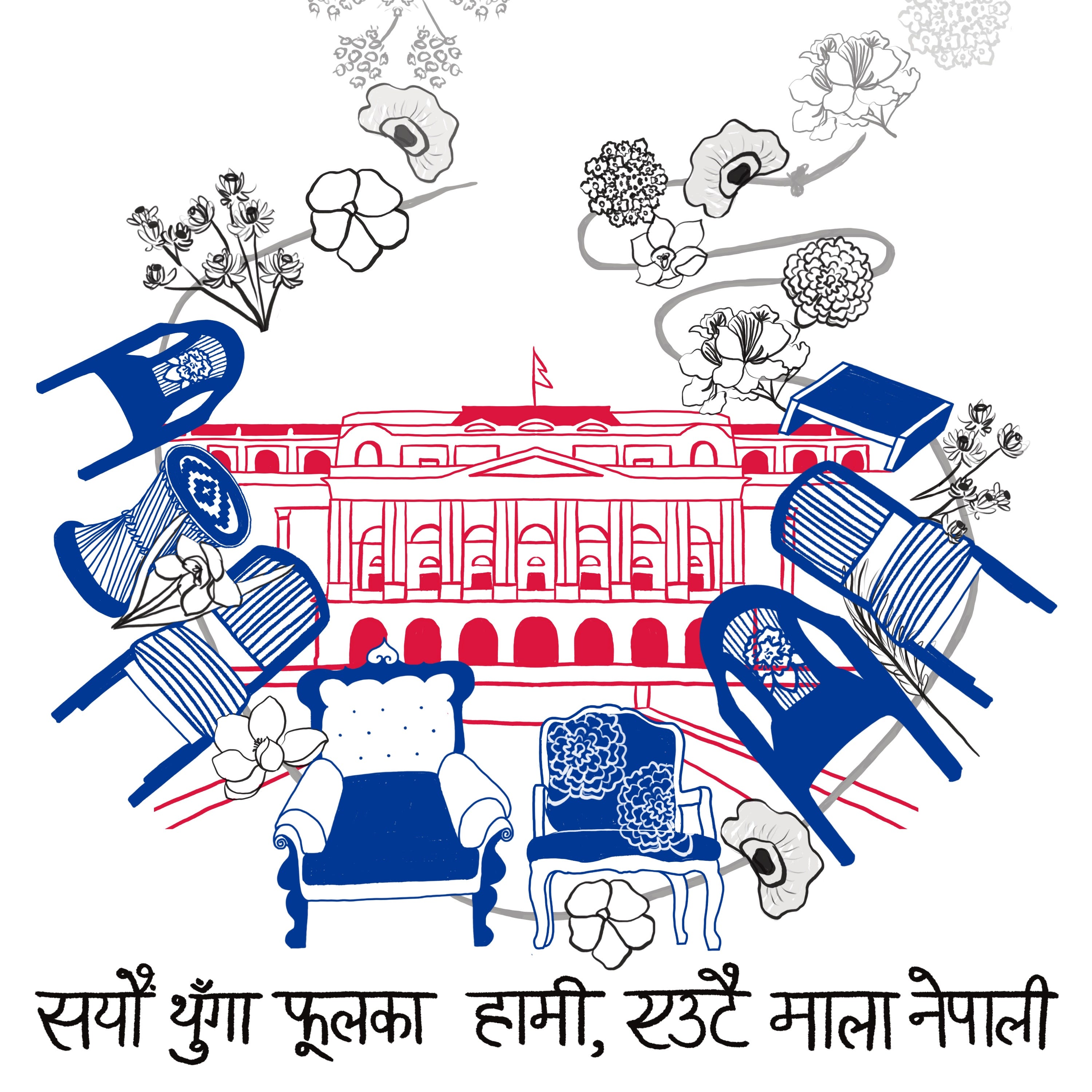
(Illustration by Manantuna Jyapoo)
The bright blue cover of the Rastriya Swatantra Party’s election manifesto depicts its vision for a prosperous Nepal. Party chair Rabi Lamichhane and its prime-ministerial candidate Balendra Shah look over a valley dotted with transmission towers, wind turbines, solar panels, flyovers, cable cars, and a wide dam. In the foreground, a man in dhaka topi points into the distance as his family looks on.
Crowded with symbols of material progress, the image declares RSP’s commitment to “set things right”, the party’s campaign promise in Nepal’s parliamentary elections following the GenZ uprising that killed more than 70 Nepalis.
The RSP went on to secure a historic majority, winning 182 out of the 275 seats in the House of Representatives, overthrowing the traditional mainstream establishment as well as regional parties.
This rupture in the Nepali political field replaced older lawmakers with a much younger cohort. Yet, underneath the generational shift, the political order remains the same. Khas-Arya men continue to dominate the list of elected representatives, reproducing centuries-old caste and gender hierarchies.
Who is actually entering Parliament?
No group has expanded its parliamentary presence more steadily than the Khas-Arya community, which makes up about 30 percent of Nepal’s population. In the March 5 election, it won 99 of the 165 directly elected First-Past-the-Post (FPTP) seats, or 60 percent. Even after the corrective proportional representation (PR) system brought in other castes and communities, Khas-Arya still account for 48 percent of parliamentarians in the 275-member House of Representatives.
The RSP also formed its 15-member Cabinet today. Ten ministers, or 66.7 percent, were men, all directly elected through FPTP, and 80 percent of them were Khas-Arya. The five women ministers, making up 33 percent of the Cabinet, reflect limited inclusion: one Madhesi woman, one Tharu woman, one Dalit woman, and two Khas-Arya women. All but one were elected through PR.
The Adivasi Janajati community, by contrast, is nearly the same size in population, making up about 29 percent of Nepal, but won only 27 FPTP seats, or 16 percent. Rather than moving closer to parity, Adivasi Janajati representation has declined in every election since 2017. This year, Adivasi Janajatis hold just 59 seats in total, or 21.45 percent.
Next in terms of population size is the Madhesi community, with 16 percent of the population. Other than Khas-Arya, it is the only major group that has moved modestly beyond its demographic size since the 2017 elections, securing 47 seats, or 17 percent of Parliament this year.
The Tharu community, which makes up 6.52 percent of the population, will have 12 seats or 4.36 percent, while the Muslim community, with a population of 4.89 percent, will have nine seats, or 3.27 percent
The gap is even starker for the Dalit community. Roughly one in every eight Nepalis is Dalit, making up 13 percent of Nepal’s population. Yet, over the last two elections, only one Dalit candidate has been elected nationwide under the FPTP system. Even with all the safeguards meant to correct such historical exclusion, the Dalit community holds just 16 seats in total, or 5.8 percent of Parliament, a strong indicator of how revolutions in Nepal have failed to make a dent, let alone dismantle, the entrenched caste hierarchy.
Another staggering disparity is how far women remain from parity. Only 14 women were directly elected, and even after all the constitutional corrections, women make up just 34.91 percent of parliament, nowhere near their 51 percent share of Nepal’s population. The exclusion is even sharper for women with intersectional identities, with over a third of women parliamentarians coming from the Khas-Arya community.
However, one of the most dramatic shifts in the 2026 parliament is the rise of younger men as the dominant bloc of lawmakers. Parliamentarians aged 36 to 50 now make up 55 percent of the House of Representatives, while those under 35 have jumped from just 3 percent in 2022 to 18 percent in 2026.
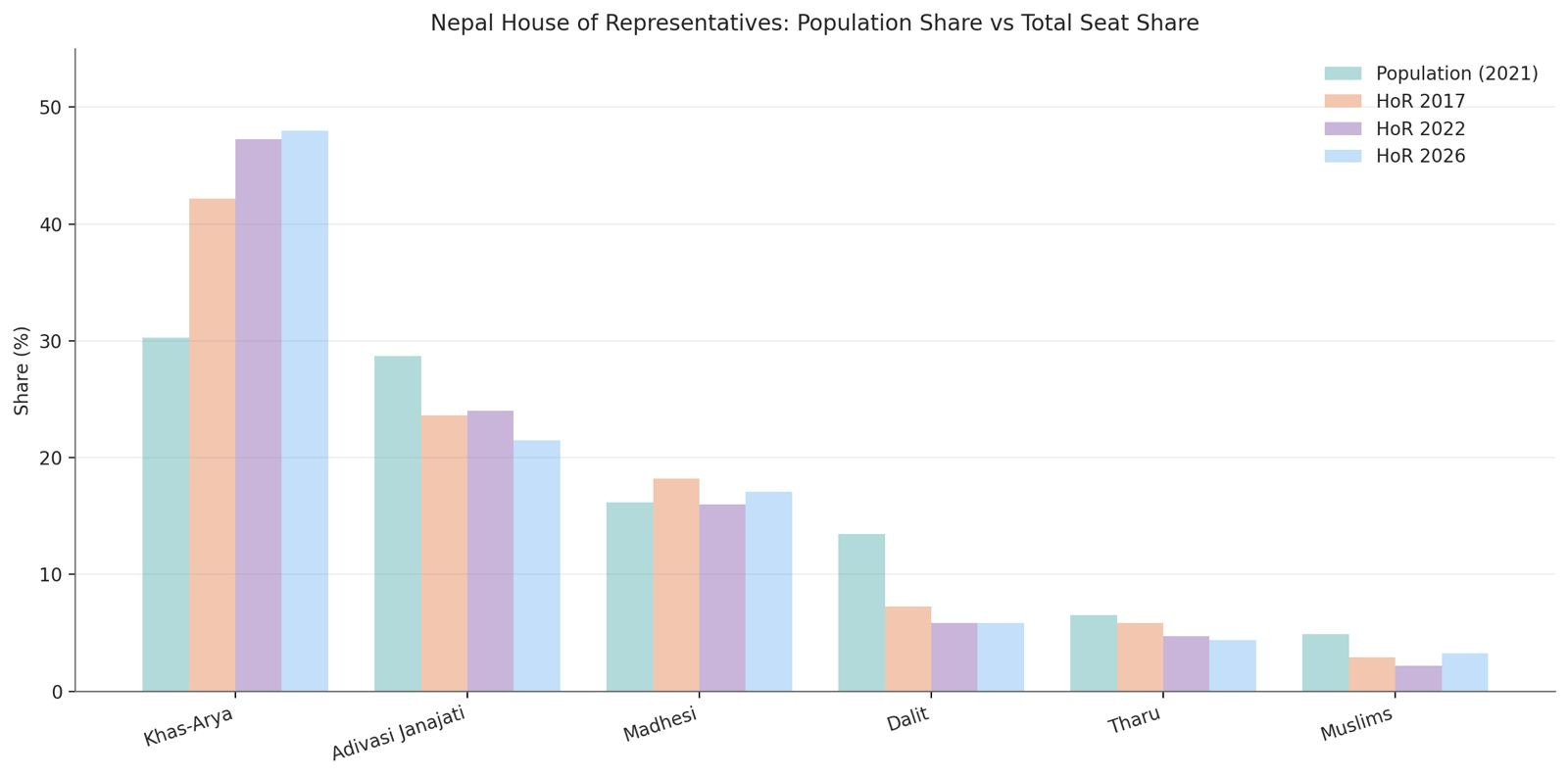
(Image: The graph is based on reports from the Nepal Madhesh Foundation’s 2026 analysis of FPTP candidates and election results, Nepal News’ 2026 FPTP cluster counts and latest inclusion shares, ekantipur’s report on the amended 2026 PR quota schedule, Rising Nepal’s report on the final 2026 PR women count, Samsad Journal’s 2022 House of Representatives FPTP, PR, and total cluster table, The Record’s 2017 House of Representatives representation analysis, and the National Census 2021.)
Unequal status of parliamentarians
The imbalance in representation between Nepal’s two electoral systems — FPTP and PR — is intentional because of the power differences between them. While researchers say electoral reform is essential for deeper inclusion, Nepal’s parliament would be far less representative of the country’s social composition without its mandatory corrective PR reservation system. First introduced during the post-conflict peace process in 2007, the system was later institutionalised in the 2015 Constitution.
The 165 FPTP representatives have the most direct route to power as they represent an entire constituency, and since the parties have already invested in them during election campaigns, they are most likely to be considered for ministerial roles.
Even though the PR route is essential to get a foot in the door, once inside the system, it does not always provide the freedom to speak up. Because the 110 PR representatives are nominated by their parties, many remain wary that speaking too assertively about their communities’ concerns could jeopardize their chances of being nominated again.
“A lawmaker, whether elected through FPTP or PR, should be equal in the parliament. But they are given two different statuses,” said Rup Sunar, a Dalit rights activist. “In the past, representatives from the Dalit community who were elected through PR have had to ask their party leaders before speaking on issues affecting their own community. They should be able to speak up independently, but they are not.”
How parties gatekeep inclusion
Inclusion measures were put in place to ensure the gradual correction of historical imbalances, but they have now become a tool to gatekeep marginalized communities from powerful FPTP roles. “Having a reservation of 33 percent for women does not mean the remaining 66 percent is a quota for men,” said political scientist Indra Adhikari.
Parties themselves hand FPTP tickets to candidates who already have money, can raise funds, and know how to move resources through party networks. “Those who stand to benefit when a party comes into government are the ones who invest in it,” Adhikari said, continuing the circulation of power among the privileged.
Adhikari pointed out that the costliest part of an election is mobilizing party cadres to campaign for a candidate. “If a woman is in the race, cadres are less likely to accompany her. They instead back candidates they see as more likely to be picked as ministers,” she said.
Tashi Lhazom, one of the few FPTP women candidates from the RSP, questioned how one can run a campaign in highland districts such as Humla without institutional support. Lhazom flagged how only those with established financial resources truly have a shot at contesting elections. Lhazom contested the Dolpa-1 constituency from the RSP but lost to Jaya Pati Rokaya of the Nepali Congress.
Similar dynamics have shaped selection for the parties’ PR lists. The RSP was widely criticized for its PR list, with many pointing out that the party had prioritized ‘elite’ individuals, even though the list was meant to provide fair representation for marginalized communities. Alarmed by how elite those lists were, activists and voters tried to intervene to push for greater inclusion. “People from marginalized communities should have been in the list, but it included those who had actively harmed indigenous rights,” said Shanken Rai, a Gen-Z movement activist.
After the backlash, some PR nominees withdrew their names from the list. One was Sachin Dhakal, the son of IME Group Director Chandra Dhakal. IME Group is behind the controversial Mukkumlung (Pathibhara) Darshan Cable Car, which has drawn widespread criticism for desecrating a sacred Limbu site revered in the Mundhum tradition. Activists say the cable car would not only violate Mukkumlung’s spiritual sacredness, but also cause extensive environmental damage.
“The entry of marginalized communities has remained limited and superficial,” said researcher Kailash Rai. “They are only now beginning to enter these spaces and have not yet been able to penetrate all layers of power. There needs to be more people with longer experience, so that inclusion can move beyond the top layer and reach the middle and lower levels as well.
Some activists even suggested suitable names for the parties’ PR lists. “We nominated Dalit women so that at least someone from the grassroots can be in the parliament,” said 30-year-old Manjita Pariyar, a researcher and Just Futures Pahal fellow.
But none of her nominations were included. “Dalits have rarely held positions of power. Dalit women, even those as old as 55, still struggle to get citizenship. Who will raise these issues in parliament?” she said.
Activists have also been dismayed at the total absence of Madhesi Dalits in the soon-to-be convened parliament. Of the 16 Dalits in Parliament, all of them are from the hills. Pariyar believes that policies designed to address the needs of the most marginalized Dalit people will ultimately benefit everyone.
Who will pay for RSP’s new Nepal?
Beyond the concerns of who is in power, this skewed representation in the RSP-led parliament will have direct implications for whose lives will bear the cost of the changes the RSP has promised in its manifesto. Without social justice, the RSP’s agenda risks reproducing existing hierarchies.
When inclusion efforts have already been stymied by the parties themselves, the RSP’s promise to introduce 100 percent meritocracy in all constitutional and strategic state institutions is very concerning. Quotas and reservations were introduced with the understanding that a level-playing field for all communities has never existed in Nepal. A fully meritocratic system would naturally privilege communities like Khas-Arya and Newa, who have long had access to socio-political capital and patronage networks. Communities like Dalits, Janajatis, and Tharus cannot benefit from meritocracy when they have been systematically excluded and denied opportunities for centuries.
The RSP has also set an ambitious target of generating 30,000MW of electricity in the next decade to boost Nepal’s economy. It has committed to amending laws to enable a ‘single-window approval’ for hydroelectricity projects. Nepal currently produces around 3,200MW of electricity, which is expected to double in the next two to three years if all under-construction projects come online. Expanding this capacity tenfold would require the construction of many more large and small hydropower plants.
“If we look at the places where hydropower projects have been built, they are often areas inhabited by Indigenous peoples, Dalit communities, economically marginalized groups, and people with little political access,” said researcher Rai.
From Kathmandu’s road expansion to Solukhumbu hydropower, the Sunkoshi-Tamakoshi river basin, the Tamakoshi-Kathmandu transmission line, and the Tanahu Hydropower Project, the costs of “development” in Nepal have repeatedly been borne by marginalized communities.
Since 2007, when an identity consciousness sparked by the 10-year Maoist war took hold of the public imagination, elections have been defined by issues such as marginalization, identity, representation, and inclusion. In contrast, the 2026 election, held in the shadow of the GenZ movement, focused on good governance, efficient systems, and an end to corruption and nepotism. The agenda of representation and inclusion, championed for so long by marginalized communities, has been sacrificed on the altar of apolitical, meritocratic, technocratic governance.
The first point in RSP’s manifesto states that inclusion is not only about meeting quotas, but is their constitutional and moral commitment to ensure meaningful and fair representation of all classes, genders, and communities at every level of the state.
“Beyond those promises in its manifesto, if we look at RSP’s other documents, such as the party statute, they say very little about inclusion,” said Dalit rights activist Sunar. “As marginalized groups, we may need to give the party the benefit of the doubt for now, but closely watch how those commitments are implemented, especially in representation, government programmes, and the budget”.
The RSP and the new prime minister, Balen Shah, have a rough road ahead. Promises for good governance and material progress will need to balance representation and inclusion concerns.
“The RSP must take forward both good governance and inclusion as equal priorities. It must tackle corruption and inefficiencies but also understand the spirit of the constitution and ensure meaningful inclusion,” said Tula Narayan Shah, a political analyst. “Since 2007, Nepal has tried to address its historical structural problems, moving from centralization to federalism and from exclusion to inclusion. But those structural problems had only begun to be resolved. RSP needs to continue this work. Otherwise, people may once again return to the streets.”
The RSP’s manifesto ends with an image depicting Lamichane and Shah breaking through a symbolic wall built by corruption, nepotism, pollution, and migration. “We have arrived,” the image declares.
But Nepal’s marginalized communities, long denied their fair share in the development and progress narratives of ‘new Nepal,’ wonder if this arrival will finally include them.
That’s all for this week. I will be back next Friday, in your inbox, with the next edition of Kalam Weekly.
If you enjoyed today’s newsletter, please consider sharing it with others who might enjoy weekly updates from Nepal or consider becoming a paid subscriber.
Thanks for reading Kalam Weekly! Subscribe for free to receive new posts and support my work.
 | A guest post by
|