

Nepal's democratic stress test
On what the elevation of three individuals to prime minister could mean for Nepal's democratic institutions



Good morning, good afternoon, and good evening from Kathmandu. This is Issue 226 of Kalam Weekly, the only newsletter you need to keep updated with everything happening in Nepal.
This week, a sobering, analytical piece from Sanjeev Satgainya, former editor of The Kathmandu Post and a regular contributor to The Hindu. He compares the three leading candidates for prime minister — Balen Shah of the Rastriya Swatantra Party, Gagan Thapa of the Nepali Congress, and KP Sharma Oli of the UML — on their democratic credentials and what their respective approaches to reform could mean for Nepal’s democratic institutions. Read more in the deep dive below.
But first, a hearty welcome to all our new readers and supporters. With the election next week, we will be bringing you more analysis and reporting on how the voting goes and the aftermath of the polls. We hope you will continue to read us and, if you can, support us, as this is an especially crucial time for us here in Nepal. Please click the button below to support us via Substack or scan the QR code to support us with your bank app.

And now, the newsletter:
Kurakani with Kalam returned
Two reports, two opposing narratives
Bus accident in Dhading claims 19 lives
Recommendations
The deep dive: Nepal’s democratic stress test
Kurakani with Kalam returned
Last Saturday, February 21, we held our second Kurakani with Kalam event at Mandala Deck in Thamel. It was a lively event with a larger turnout than I had imagined. We had over 60 people, young and old, sitting together, talking and hopefully, learning a bit more about each other and ourselves. Our misinformation quiz was a hit, with many telling us that they learned something new, and our Coffeehouse-style Conversations sparked dialogue among strangers. We talked about politics, democracy, and the kind of future we imagine for Nepal.
Thank you to everyone who joined us in person. We hope you had as good a time as we did. Thank you to our venue partner, Mandala Deck, a great bar in Thamel that you should definitely visit, and to Booksphere, a small online-only bookstore that goes above and beyond to get you the books you want. Thanks also to Bibek Gautam, our excellent MC, photographer Aman Shahi of Thaukothau Productions, and our volunteers for all their hard work!
We hope to do more of these events in the future, so please stay tuned to this newsletter. In the meantime, click here for photos from the event.
Two reports, two different narratives
On Thursday, February 26, the BBC released an investigative video documentary and an accompanying article about the September Gen Z protests, focusing on September 8, the first day of protests that saw over 19 young Nepalis killed in cold blood by the Nepal Police and the Armed Police Force.
The BBC report revealed a broad intelligence failure by the security agencies. Authorities underestimated the size of the crowd, which the BBC estimates at around 30,000. The heads of the security agencies were gathered in a control room at Singha Durbar, but the room lacked a steady stream of visual feeds from the numerous cameras around the Parliament building. The officials were, in effect, operating blind. At 12.30, Chhabi Lal Rijal, the chief district officer for Kathmandu, issued a curfew order, and police began ordering people to go home.
By this time, the protest had escalated. Protesters were pelting security forces with stones and had breached the gates of the Parliament building. Parliament was not in session at the time, and there were no lawmakers inside the building. Police officers on the ground asked to be allowed to use live ammunition to protect themselves, and just 10 minutes after the curfew order had been issued, a senior police officer with the callsign P1 said this over the radio: “Curfew already in place. No further need to obtain permission. Deploy necessary force.” The BBC identified the P1 callsign as belonging to then Inspector General of the Nepal Police, Chandra Kuber Khapung.
Khapung has since retired, but he testified before the authorities that he had not made the call to use deadly force and that the decision was made by the security committee led by CDO Rijal. As police began firing blindly into the crowd, 19 unarmed protesters were shot dead. Forensic reports later revealed that the vast majority had been shot in the head and chest, when the police’s directive on use of deadly force requires officers to aim below the waist. “Our officers fired on them like they were enemies,” one anonymous police officer told the BBC.
You can watch the BBC documentary here, and read the accompanying article here. Fair warning, the documentary is graphic and details numerous deaths.
The report set off a firestorm on Nepali social media. To many, it was a reminder of the unnecessary bloodshed that led to the violent protests of September 9, but others saw it as an attempt to influence the election and called it “selective” and “manipulative.” The timing of the documentary’s release was widely criticized, including by Shankar Pokhrel, general secretary of the UML, who called it evidence of “geopolitical maneuvering.”
Towards the end of the day, another report would emerge, this time from a Nepali outlet. Himalkhabar published its own lengthy report on the protests, but focused instead on September 9. The report alleges that Hami Nepal, a nongovernmental organization, and its chief, Sudan Gurung, were behind the widespread arson and violence of September 9. It cites CCTV footage showing Gurung and his Hami Nepal team appearing at numerous locations across Kathmandu, after which violence would take place. The report does not cite any footage showing Gurung or his team involved in arson or violence; it only states their “suspicious presence” and their coordination over walkie-talkies. It also links Gurung with then Kathmandu Mayor Balen Shah and the Rastriya Swatantra Party, alleging collusion between the three.
The Himalkhabar report puts together numerous points of suspicion, like the involvement of black-clad men wearing face masks and combat jackets, a biker group calling itself ‘Tibetan Original Blood’, the role of Balen Shah, and the widespread arson and violence on September 9 that appeared coordinated. There is room for suspicion that unscrupulous actors might have been involved and instigated the violence. These questions must be asked, but the media should also attempt to answer them with verifiable evidence, not insinuations. The BBC investigation presents tangible evidence that we can examine and decide for ourselves whether it is credible. The Himalkhabar report does not.
This is my assessment, but others might disagree. You can make up your own mind by reading/watching both reports. You can read the full Himalkhabar report here in Nepali.
Bus accident in Dhading claims 19 lives
On Monday, February 23, a bus travelling from Pokhara to Kathmandu veered off the Prithvi Highway in Benighat, Dhading district, hurtling 200 meters onto the banks of the Trishuli River. Nineteen passengers, including a British man, a Chinese woman, and an Indian man, were killed; 25 others were injured. Later the same day, 15 Nepalis were injured in a bus accident in Udaypur, and nine more were injured in yet another bus accident in Dang.
Nepal’s roads are a death trap. According to data from the Nepal Police, over 24,000 people have been killed in the last 10 years in road accidents, a higher death toll than the 10 year civil conflict. Just last year, 2,549 people were killed in road accidents. There are numerous causes behind these all-too-frequent accidents — poor road infrastructure, improperly maintained buses, overloading, overworked drivers, and inclement weather. Many roads are built without proper environmental assessments, leading to steep inclines, hairpin turns, and increased vulnerability to landslides and flooding. Many of these causes can be attributed to the presence of contractors as legislators and elected representatives at the provincial and local levels. Once in power, contractors obtain lucrative government tenders to build roads. Locals often support these poorly built roads as they bring connectivity, mobility, and increased land prices. The cost, however, is thousands of Nepali lives.
Sonia Awale put it best in her 2025 article in Nepali Times titled ‘Roadkill’: “Nepalis are not dying on the country’s highways, they are being killed.”
For more, read last week’s newsletter from Boju Bajai:

Recommendations
Article: Who is accountable for teacher-student relationships? by Subeksha Poudel, Nepali Times
Article: Phanishwar Nath Renu’s story of Nepal’s 1950–51 insurrection by Phanishwar Nath Renu and Ratik Asokan, Himal Southasian
The deep dive: Nepal’s democratic stress test
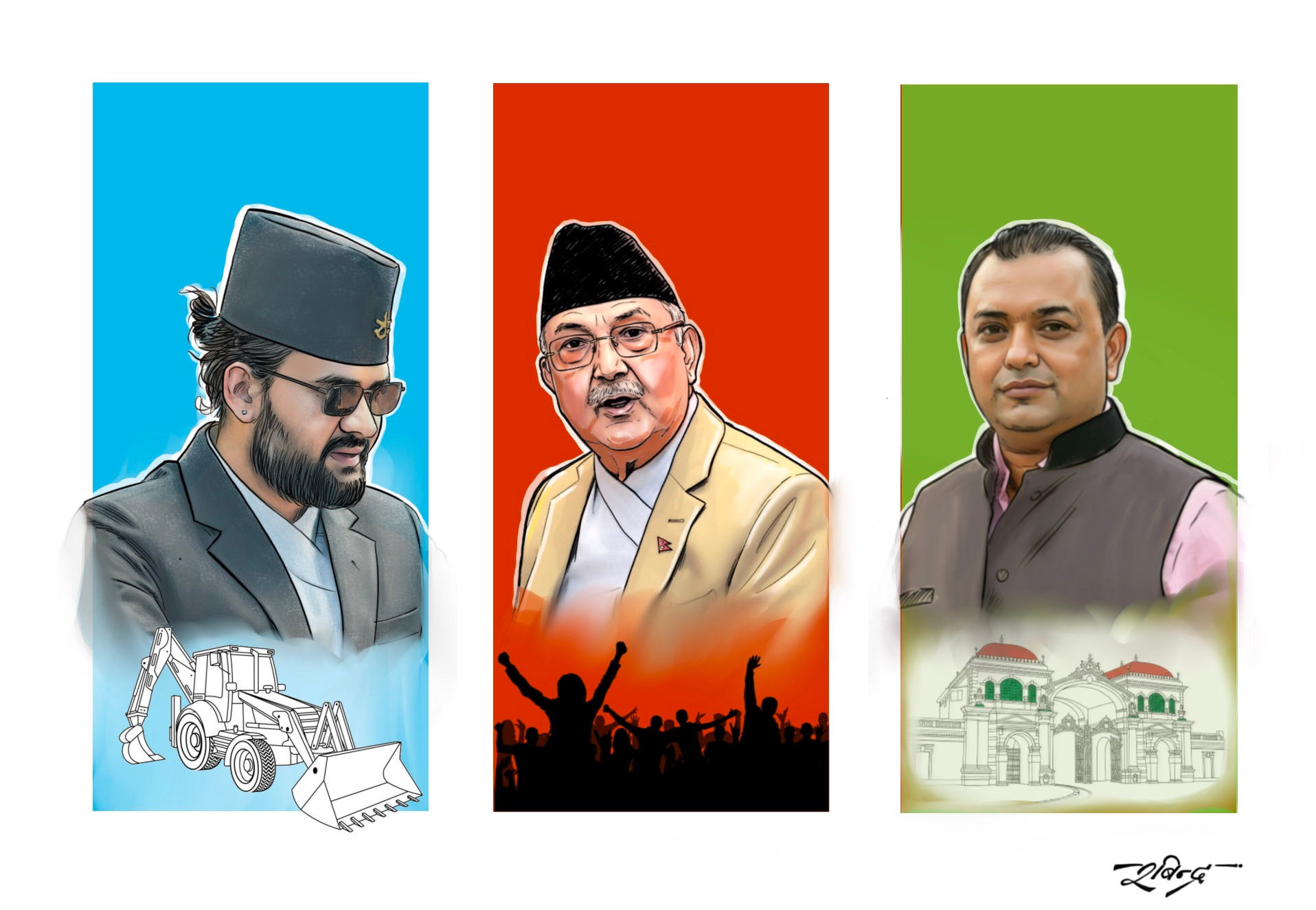
Image: Rabindra Manandhar
With less than a week to go before Nepal goes to election, triggered by September’s Gen Z protests, ‘change’ is the dominant watchword.
Yet beyond that refrain, there is little clarity about what kind of change the ballot will actually deliver — and at what institutional cost.
Elections can renew leadership; they do not automatically renew institutions. And democracy is about institutions.
Nepal’s 36-year democratic journey — 18 of those years as a federal democratic republic — has produced representation and rotation of power, but not always administrative depth or consistent service delivery, both of which are often tied to government stability. The result has been a widening trust deficit between the political parties that have ruled Nepal and the public at large.
The upcoming vote is thus unique. Elections in a multi-party democracy are about political parties, but this election is about something more — competing interpretations of how a democracy should function: quick and disruptive, procedural and reformist, or experienced and centralized.
Three figures who are currently dominating the national conversation exemplify these three interpretations: the Rastriya Swatantra Party’s (RSP) Balendra ‘Balen’ Shah, an outsider-turned-symbol of impatience; the Nepali Congress’ Gagan Thapa, an institutional reformist; and the CPN-UML’s KP Sharma Oli, a seasoned centralizer of executive power.
On the ground, there is a palpable wave in favour of the RSP, founded in 2022 as an insurgent alternative to the political establishment. If so, Shah, as promised by his party, would become prime minister. A majority government, in theory, would ensure stability — a government that serves a full five-year term is something Nepalis have long yearned for. But is stability necessarily good? Not always, for reasons that become clearer when we examine the democratic implications.
If the RSP fails to secure a majority, no other party is likely to achieve it, given Nepal’s plethora of political parties and established patterns of voter fragmentation. In the wake of the Gen Z uprising, the Nepali Congress has attempted a revamp, with the old leadership pushed aside and Thapa installed as the new party president. Despite the Congress 2.0 push, Thapa is unlikely to win a majority for his party — not to blame him per se, but rather his party, which is fragmented and viewed by many as a perpetuator of the status quo and patronage politics. Oli, meanwhile, has become a villain in many people’s eyes over the killings of September 8, the first day of the Gen Z protests, and this will affect the UML’s poll prospects as he has stubbornly refused to relinquish party leadership.
That said, Nepal’s electoral system is such that a hung parliament is almost always likely. Coalitions are therefore the most probable outcome. Since the tone is set from the top, the next prime minister will determine how Nepal balances delivery with restraint.
The real issue, therefore, is that this election is as much a democratic stress test as it is a vote.
Balendra Shah: Speed as reform
Shah’s political rise since his upset victory in Kathmandu’s 2022 mayoral election has been rooted in anti-incumbency. As the city’s mayor until this January, he projected decisiveness, visible action, and a willingness to confront entrenched interests. Since he won the mayoral post as an independent, he was not burdened with party baggage. Now, however, he is a ‘senior leader’ in the RSP, which dramatically changes the stakes. He will have to shoulder the fraud and embezzlement accusations against party chair Rabi Lamichhane, which are still pending in court. Still, his appeal remains generational and disruptive. To many, he represents rupture with an exhausted and discredited political class.
But disruption carries institutional risks. The rush of ‘delivery’ politics often views oversight and checks and balances — which are fundamental to democracy — not as safeguards, but as hurdles. This impulse toward speed threatens to erode the very constitutional guardrails designed to prevent decisive leadership from turning into unchecked authority.
Furthermore, Shah, 35, lacks parliamentary experience. Singha Durbar, the seat of the federal executive, demands a level of legislative rigor and consensus-building that City Hall does not. He has yet to get a handle on the demanding, structural grind of Nepali politics. Negotiation with coalition partners, provincial governments, and constitutional bodies is not optional — it is an integral part of parliamentary politics.
Shah’s mayoral style leaned towards centralized decision-making and one-directional communication via social media. This ‘digital pulpit’ has exposed his impulsive streak. His past provocations — from a threat to “burn down Singha Durbar” to using profanity against neighboring countries and the political class — raise a critical question: is he a transformative national leader, or simply a hot-headed, volatile young man?
Shah’s reluctance to adhere to established processes was evident in the early days of his mayoral tenure, when he used bulldozers to raze illegally constructed structures with minimal notice. An episode during his mayoral tenure — defiance of a court order regarding the removal of the parking area at Norvic Hospital— had attracted a contempt of court charge.
While supporters see resolve in his actions, critics find them discomforting. At the national level, such instincts would be subject to far more constitutional guardrails. Nepalis longing for “delivery” may find Shah’s focus on action and speed appealing. Yet, democracy is intentionally and inherently process-heavy. Consultation slows decisions but legitimizes them. A majority government under Shah could produce pace, but if not institutionally grounded, it risks undermining the very norms that make reform lasting. An excessive focus on speed and efficiency can inadvertently hollow out the democratic soul of the state.
Gagan Thapa: Reform through process
Thapa represents a different proposition of change — reform from within institutions rather than rupture against them. From a rabble-rousing student leader, Thapa has evolved over the years into a politician whose persona is rooted in policy discourse, institutional literacy, and procedural engagement. He speaks the language of pluralism, transparency, and economic restructuring. In democratic terms, this aligns with rules-based governance.
Thapa has not been associated with constitutional brinkmanship or executive defiance of judicial authority. Yet institutional reformism comes with its own vulnerabilities. He has years of legislative experience, but at the executive level, he is untested. Managing a national coalition in a fragmented system where multiple interest groups converge and collide demands trade-offs, which can dilute reform.
Despite its governance failures, association with patronage networks, and role in fueling bureaucratic inertia, the Nepali Congress, as a party, has anchored itself to democratic values and constitutionalism. Since Thapa comes from the Congress stable, few can question his commitment to democratic norms and pluralism.
Yet reform from within entrenched systems is structurally difficult.
Reform through institutions may sound appealing — and democratic — but there is a paradox: the very structures he seeks to employ for reform are themselves the primary sources of inertia. His ‘delivery’ attempts are likely to be hamstrung by structural constraints — both internal and systemic.
Thapa has to navigate a deeply entrenched patronage system within the Nepali Congress that has often prioritised loyalty over merit. Systematically, as prime minister, he would sit at the top of a bureaucracy that believes in procedural survival, where following the rulebook serves as a shield against taking decisive action. A parliamentarian for four terms over 18 years, Thapa, at 49, is not free from criticism. Critics call him a master of the ‘what’ — articulating lucidly what needs to be done — but largely falling short of providing answers to how things should be done. His test will be bridging the gap between the ‘what’ and the ‘how’.
In a society that is thirsting for immediate change, process-driven reform may be perceived as inadequacy. The risk of democratic backsliding under Thapa is low, but failure — or perceived failure — on delivery poses the risk of fuelling further public frustration.
KP Sharma Oli: Authority and concentration
Oli is an old hand. He has led the country three times — on one occasion, with a close-to-two-thirds majority in Parliament. Yet, he is not remembered for delivery.
A seasoned politician, Oli, 74, understands the mechanics of governance, coalition management, and bureaucratic navigation. Oli knows that in moments of uncertainty and confusion, authority can project stability, and he is adept at exercising command and control. And this is not just rhetorical; it’s rooted in a pattern. He recently consolidated party authority, amending the party statute to serve a third term as chairman. He has largely molded the party structure around his image, leaving little room for dissent.
Past episodes — such as the controversial dissolutions of Parliament later overturned by the Supreme Court — illustrate both his hubris and comfort with testing constitutional boundaries. Oli claims to be democratic — he generally respects electoral outcomes — but his preference for centralized decision-making and strong executive control may limit pluralism.
In early 2025, his Cabinet pushed through an ordinance amending a slew of laws at once, arguing that the “sluggish” parliamentary process hindered investment and economic growth. It is worth noting that Thapa had supported Oli at the time. While supporters saw the ordinance as cutting through red tape, critics alleged that amending laws via executive ordinance undermined the legislative process, arguing that the end does not justify the means.
Oli’s authoritarian tendencies have also been evident in his systematic effort to centralize the state’s powerful levers. During his tenure as prime minister in 2018, he brought the Department of Money Laundering Investigation, the Department of Revenue Investigation, and the National Investigation Department — agencies traditionally overseen and controlled by the Finance and Home Ministries — directly under the Prime Minister’s Office, effectively under his own purview.
Despite this concentration of power, the government under Oli was largely unsuccessful in combating corruption or improving public service delivery. Instead, Oli garbed his failures in assertive rhetoric, political manoeuvring, and nationalist sentiment, thereby leaning more towards theatrics than substance.
Oli does not test democracy through inexperience; he tests it through a concentration of power. A return to his leadership, which is looking unlikely, could perpetuate the same administrative stagnation and short-term coalition-survival politics that pushed the populace to revolt. Simultaneously, it could also revive concerns about executive assertiveness, power consolidation, and wilful misinterpretations of constitutional norms.
Faces and stakes
Measured against democratic parameters — rule of law, institutional restraint, press freedom, civic space, and governmental temperance — all three prospective prime ministerial candidates present distinct stress points.
Shah risks institutional bypass in pursuit of speed. His mayoral record does not prominently feature participatory policymaking structures. His reliance on unidirectional communication via social media limits exposure to adversarial questioning. There is no record of systemic media suppression under his watch, but neither is there a well-tested record of tolerance for sustained criticism at the national scale. Meanwhile, Lamichhane, Shah’s party chief as head of the RSP, has not hesitated to rail against the media, accusing it of being in cahoots with the political establishment.
Thapa risks institutional inertia in pursuit of procedural legitimacy. He generally maintains a communicative posture towards the media, engaging in interviews and positioning himself as a defender of press freedom. He has thrived on media visibility, but this very style risks making him look more performative than substantive. Consequently, the status quo is likely to be preserved — neither shrinking nor significantly expanding press space. Thapa views social media as a democratic space, yet his past views on its regulation have been sketchy. He has at times remained silent while governments with his party as coalition partners drafted restrictive digital legislation, only to distance himself after public backlash. When Oli blocked 26 social media platforms in September last year, sparking the Gen Z protests, the Congress was again the primary political ally.
Oli risks institutional strain through executive consolidation. His relationship with the press has been more combative, yet he does entertain the media. It is a different matter that his press conferences are often unidirectional and preachy. His tenure saw tensions with media outlets and proposed regulations that critics viewed as restrictive. He has at times portrayed critical journalism as partisan. While he has a team to operate his social media handles, he holds a dim view of the medium. His government’s decision to ban social media platforms was the catalyst for the Gen Z protests.
The stability chimera
There is, however, a persistent belief in Nepal that delivery failures are due to the absence of a stable government. This perception risks snowballing into a deeper crisis as the blame gradually shifts from politicians to the democratic system itself.
Nepal’s recent history is marked by short-lived governments and fragile coalitions. In such a climate, ‘stability’ is politically seductive; it makes a good political slogan. But stability achieved through excessive concentration of authority can weaken democratic guardrails. It is a paradox that perpetual coalition fragility can, at the same time, erode public faith in democracy’s capacity to deliver.
The Gen Z protests were not driven by ideological treatises. They were expressions of exhaustion — with corruption, with impunity, with the status quo, with gerontocracy, with drift. But, impatience alone cannot effect democratic renewal; experience alone cannot secure it; and procedural virtue alone cannot deliver it.
Beyond personalities
It may be tempting to frame this election as outsider versus insider, youth versus veteran, reform versus establishment. That framing oversimplifies the stakes. The more precise question is institutional: can Nepal reconcile urgency with restraint?
Democracy’s greatest danger is not only overt backsliding; it is slow erosion — when institutions weaken under expediency, when concentration feels efficient, or when proceduralism becomes paralysis.
Nepal’s upcoming vote will not simply determine who governs. It will signal how the country chooses to balance speed, authority, and restraint and define Nepal’s next phase of its democratic path. What form of change it will bring — disruptive, procedural, or centralized — will determine whether Nepal’s democracy deepens, erodes, or merely survives.
And that, more than the arithmetic of seats, is what is truly at stake. That is the democratic test Nepal is facing this election.
That’s all for this week. I will be back next Friday, in your inbox, with the next edition of Kalam Weekly.
If you enjoyed today’s newsletter, please consider sharing it with others who might enjoy weekly updates from Nepal or consider becoming a paid subscriber.
Thanks for reading Kalam Weekly! Subscribe for free to receive new posts and support my work.
 | A guest post by
|